

06 Jul What Are Panic Bars on Doors, and Does My Business Need Them?
If you have ever pushed a horizontal bar to burst out of a crowded store or theater, you have already used one — but many owners still ask what are panic bars on doors and does my business need them, especially when a fire marshal brings it up. In short, a panic bar is a spring-loaded latch release that spans the inside of an exit door so anyone can open it instantly with a simple push, even in a chaotic emergency. For business owners in Tulsa, OK, whether you are required to have one depends mostly on how many people your building holds and what kind of occupancy it is. Getting this right is both a safety issue and a compliance issue.
At Tulsa Lock & Key, we install and service exit hardware for local businesses, so here is a clear, practical rundown.
What Are Panic Bars on Doors?
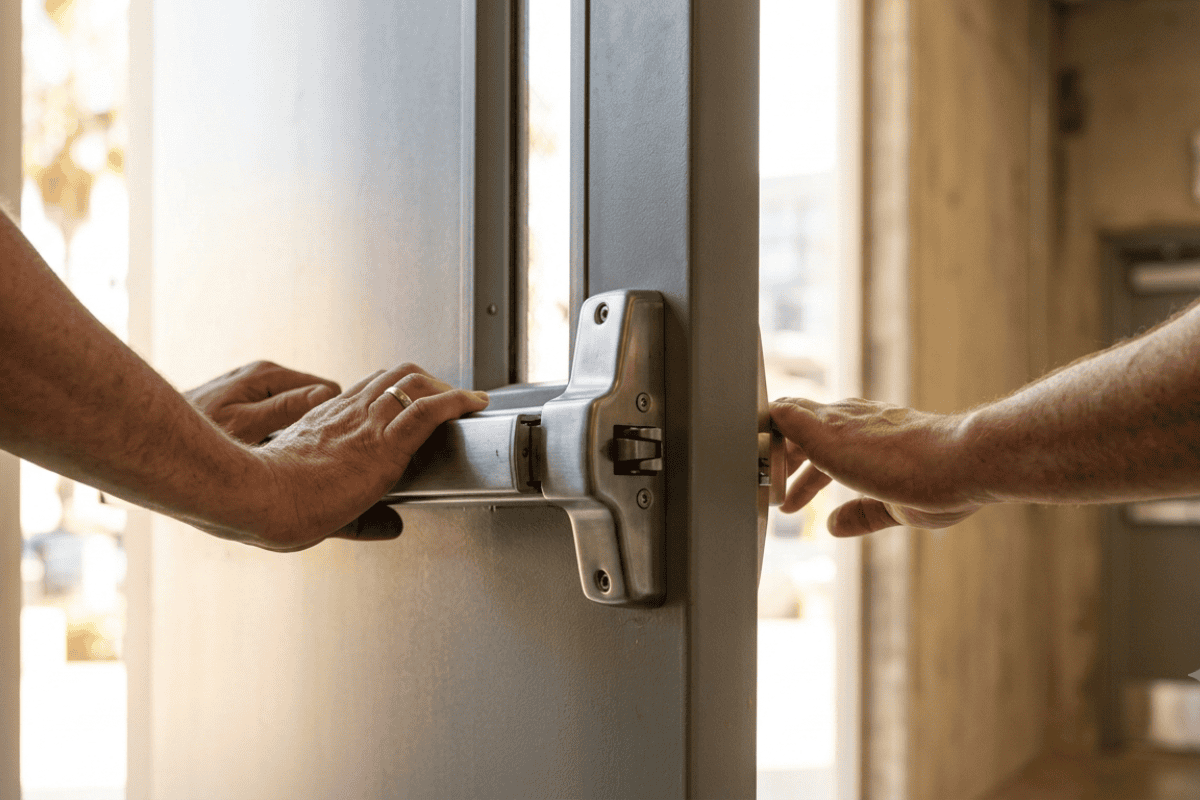
A panic bar — also called a crash bar, push bar, or exit device — is a mechanism mounted horizontally across the interior of an outward-swinging door. Pushing anywhere along the bar retracts the latch and opens the door immediately, with no knob to turn, no thumb-turn to find, and no key required from the inside. That simplicity is the entire point: in a fire, a power failure, or a stampede, people can escape by simply leaning into the door.
This function is central to what building codes call the means of egress — the path everyone uses to get out safely. Federal workplace rules also require that exits stay unobstructed and openable from the inside without keys, tools, or special knowledge, which is exactly what a panic bar guarantees.
Does Your Business Actually Need One?
Whether panic hardware is mandatory comes down to your occupancy classification and occupant load under widely adopted model codes such as the International Building Code and NFPA 101. As a general rule, doors that can be locked or latched and serve an Assembly occupancy (like a restaurant, bar, or theater) with an occupant load of 50 or more require panic hardware. The same 50-or-more threshold applies to Educational occupancies such as schools. High-hazard occupancies, where flammable or dangerous materials are present, require panic hardware regardless of how few people are inside. Most small offices and shops below those thresholds are not strictly required to have panic bars, though their exit doors must still open freely from the inside.
| Occupancy type | Panic hardware generally required? |
|---|---|
| Assembly (restaurant, bar, theater) | Yes, at an occupant load of 50 or more |
| Educational (schools) | Yes, at an occupant load of 50 or more |
| High-hazard (Group H) | Yes, regardless of occupant load |
| Most small offices / shops (under 50) | Not strictly required, but exits must open freely |
Because exact thresholds vary by code edition and by what your local authority has adopted, the safest move is always to confirm with the local fire marshal or building official for your specific address. The published code sets the baseline, but the local authority has the final say.
Not sure where your building stands? Call Tulsa Lock & Key for a professional exit-hardware assessment.
Accessibility and Everyday Benefits
Panic bars are not only about fire codes. They also support accessibility, since a bar that opens with a simple push meets the intent of the ADA’s requirement that operable parts of a door be usable without tight grasping, pinching, or twisting of the wrist. The ADA’s accessible design rules, developed alongside federal accessibility standards, make easy, low-effort operation a core goal — and panic hardware delivers exactly that for people of all abilities. Beyond compliance, there are day-to-day advantages worth considering.
- Faster, safer evacuation during fires, power outages, or emergencies.
- One-motion exit that works even in darkness or heavy smoke.
- Reduced liability by meeting recognized life-safety expectations.
- Options with alarms or exit delays to deter unauthorized use.
Modern exit devices can also be paired with access control so the door stays secure from the outside while remaining free to exit from the inside — the best of both worlds for a busy Tulsa business.
Why Choose Tulsa Lock and Key
Tulsa Lock & Key has outfitted businesses across Tulsa, OK with compliant, reliable exit hardware for decades. Our technicians understand how local code is applied, can recommend the right device for your occupancy, and install it so it passes inspection and performs when it matters. We offer honest guidance on what you actually need, whether that is a single storeroom exit or a full building of coordinated devices. With skilled installation and clear communication, our business security team keeps your people safe and your doors up to code.
Conclusion
So, what are panic bars on doors and does my business need them? They are push-to-exit devices that let anyone escape instantly, and whether you are required to install them depends on your occupancy type and occupant load under adopted building codes. Assembly and educational spaces with 50 or more people, and all high-hazard spaces, generally need them, while smaller businesses still must keep exits freely openable. When you want certainty instead of guesswork anywhere in the Tulsa area, call Tulsa Lock & Key and let our experts get your exits right. Pair them with solid locks for complete protection.
Ready to get your exits compliant? Contact Tulsa Lock & Key for a business consultation.
Frequently Asked Questions
When are panic bars required by code?
Under widely adopted codes, panic hardware is generally required on latched or locked exit doors serving assembly or educational occupancies with an occupant load of 50 or more, and on all high-hazard occupancies regardless of occupant load. Thresholds can vary by code edition and local adoption. Your local fire marshal or building official makes the final determination for your address.
What is the difference between a panic bar and a fire exit device?
A standard panic bar is designed to allow fast, free egress from a non-fire-rated door. A fire exit device performs the same push-to-exit function but is also fire-rated and does not include a mechanical dogging feature that would hold the latch open. Fire-rated doors must keep their latch engaged to help contain fire and smoke.
Can panic bars be locked from the outside?
Yes. Panic bars are designed to always allow free exit from the inside, but the outside can be locked with a keyed cylinder, lever trim, or an access-control reader. This lets you keep people out while never trapping anyone in. Locking or blocking the inside egress function, however, is a serious code violation.
What is the purpose of a crash bar?
The purpose of a crash bar is to let people exit a building quickly and intuitively during an emergency by simply pushing on the door. It removes the need to turn a knob or find a lock, which saves critical seconds when a crowd is trying to leave. This reduces the risk of injury or entrapment during fires and other emergencies.
How much does it cost to install a panic bar?
Costs vary widely based on the device type, door material, and whether it is fire-rated or connected to access control, but many single-door installations fall in the low hundreds of dollars for hardware plus labor. Fire-rated and alarmed devices cost more. A professional assessment gives you an accurate quote for your specific doors.
Sorry, the comment form is closed at this time.