

25 Sep How Do I Add Security to a Home With No Existing System?
Thousands of houses in Tulsa, Oklahoma were built between the 1950s and the 1980s with a single keyed knob on each exterior door, no deadbolt, no sensors, and a porch light on a manual switch, and a large share of them are still set up exactly that way. If you have just bought or moved into one and are asking “how do I add security to a home with no existing system,” the useful answer is not a product name. It is a sequence: fix the physical weak points first, add light and visibility, then layer on sensors, an alarm, and cameras in the order that delivers the most protection per dollar.
This guide lays out that sequence, explains what the research says about which steps actually turn burglars away, and shows how a security company approaches a home that is starting from zero.
Start With the Doors, Because That Is Where Burglars Start
The FBI’s burglary statistics show that 62.8 percent of burglaries target residences, 55.7 percent involve forcible entry, and the average loss per burglary is $2,661. Forcible entry at a house overwhelmingly means a door, and a door with only a spring-latch knob can be forced with a shoulder or a screwdriver. The first upgrade on a home with no system is therefore a deadbolt on every exterior door, paired with a rekey so no previous owner, tenant, or contractor still has a working key.
The Seattle Police Department’s burglary prevention checklist specifies a deadbolt with at least a 1-inch throw, a solid-core or metal exterior door, and a strike plate anchored with 3-inch screws that reach the wall stud rather than just the door jamb. Those three details cost very little and are the difference between a door that holds under a kick and one that splinters. Sliding glass doors get a secondary bar or pin lock, and any door with glass within arm’s reach of the thumb-turn gets a double-cylinder deadbolt or a relocated lock.
Add Light and Remove Hiding Spots
The second layer is visibility. Burglars prefer to work unseen, so overgrown shrubs against windows, a dark side yard, and a fence that hides the back door all work in their favor. Trim landscaping below window sills, keep the gate to the backyard locked, and light every entry point.
The U.S. Department of Energy’s guide to lighting controls recommends combining a motion sensor with a photosensor for outdoor security lights, so the fixture only comes on when it is dark and someone is present. That setup uses less electricity than a dusk-to-dawn floodlight and is more effective, because a light that suddenly switches on draws attention in a way a constant glow does not.
Layer Three: Sensors and an Alarm
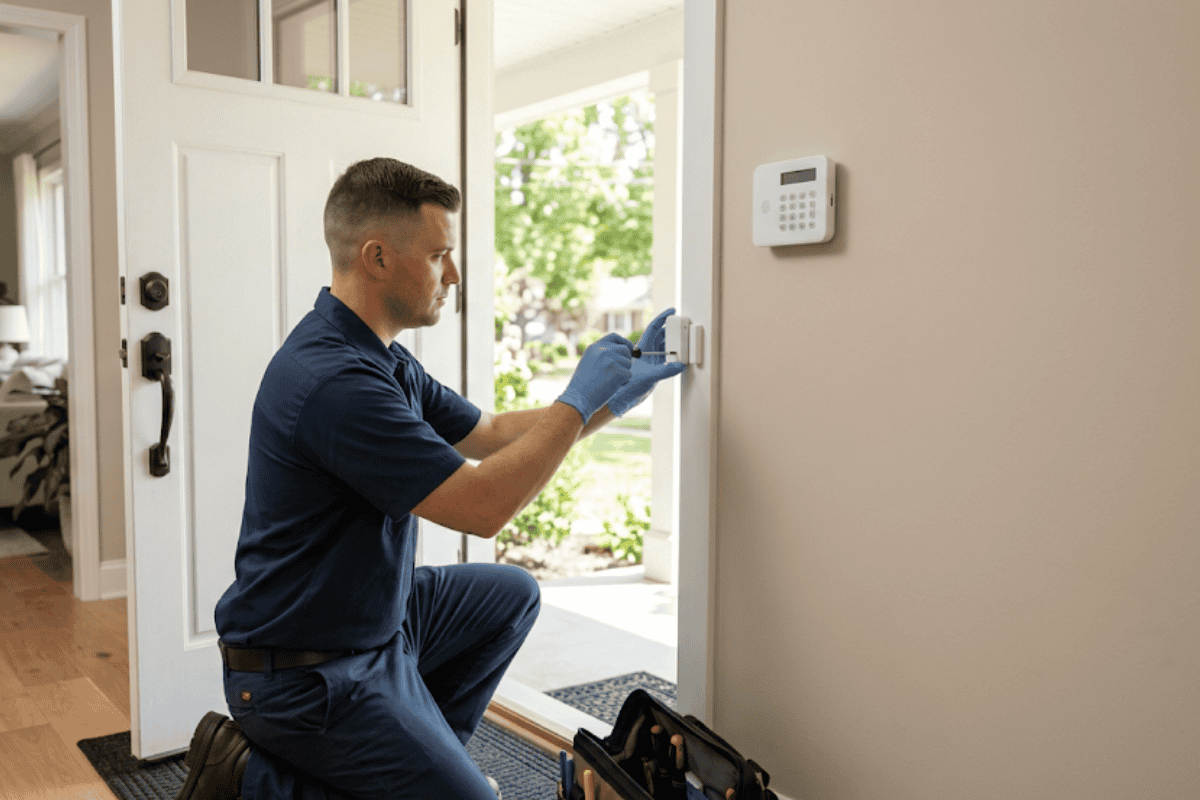
Once the doors are solid and the yard is lit, the next step is detection. A basic alarm system has three parts: contact sensors on doors and windows, one or more motion detectors covering the main living areas, and a control panel or hub that sounds a siren and sends an alert to your phone. Our explainer on how door and window sensors work covers the magnet-and-reed-switch design that makes them so reliable.
Whether an alarm changes a burglar’s behavior is not a matter of opinion. The University of North Carolina at Charlotte’s burglar study, which surveyed more than 400 convicted burglars, found that about 60 percent would choose a different target if they found an alarm present, and roughly half who discovered an alarm mid-attempt abandoned the break-in. For a home with no existing system, a wireless panel with cellular backup avoids running wire through finished walls and keeps reporting even if the internet or power drops. If the house has an old, disconnected panel from a prior owner, much of that equipment can often be reused with an upgraded cellular communicator rather than replaced.
Layer Four: Cameras
Cameras come last, not first, because they record events rather than prevent entry. Their value is in deterrence at the front door, package protection, and evidence. A doorbell camera covering the porch and one or two exterior cameras covering the driveway and back door are enough for most homes. Place them high enough to avoid tampering, angle them to capture faces rather than the tops of heads, and make sure they are on a network with a changed default password and current firmware.
How Do I Add Security to a Home With No Existing System? The Four Layers
| Layer | What to add | What it addresses |
|---|---|---|
| 1. Doors and locks | Deadbolt with a 1-inch throw on every exterior door, strike plate with 3-inch screws, rekey all locks, secondary lock on sliding doors | Forcible entry, which the FBI reports in 55.7 percent of burglaries, and old keys still in circulation |
| 2. Light and visibility | Motion-plus-photosensor lights at each entry, trimmed shrubs below sills, locked side gate | Concealment, the condition burglars rely on to work unseen |
| 3. Sensors and alarm | Door and window contacts, motion detectors, wireless panel with cellular backup and phone alerts | Detection and deterrence; about 60 percent of surveyed burglars would pick another target if an alarm is present |
| 4. Cameras | Doorbell camera plus one or two exterior cameras on the driveway and back door | Evidence, package theft, and visible deterrence at the entry |
The table restates the plan in order. Layer one is doors and locks: a deadbolt with a 1-inch throw on every exterior door, a strike plate with 3-inch screws, a rekey of all locks, and a secondary lock on sliding doors, which addresses forcible entry, reported in 55.7 percent of burglaries, and old keys still in circulation. Layer two is light and visibility: motion-plus-photosensor lights at each entry, trimmed shrubs below sills, and a locked side gate, which addresses concealment. Layer three is sensors and an alarm: door and window contacts, motion detectors, and a wireless panel with cellular backup and phone alerts, which provides detection and deterrence, given that about 60 percent of surveyed burglars would pick another target if an alarm is present. Layer four is cameras: a doorbell camera plus one or two exterior cameras on the driveway and back door, for evidence, package theft, and visible deterrence.
The Financial Side
Adding security to a home with no system has a return beyond peace of mind. The Insurance Information Institute notes that most insurers offer insurance discounts for security devices including burglar alarms and deadbolt locks. Ask your agent which upgrades qualify and what documentation they need, because a monitored alarm certificate is often worth a larger reduction than a self-installed device. The FBI’s $2,661 average loss figure also does not count the cost of repairing a kicked-in door, replacing a frame, or the days spent dealing with the aftermath.
Why Choose Tulsa Lock & Key to Build Your First System
A home in Tulsa, Oklahoma with no existing security system needs a plan that starts at the door hardware and ends at the camera, and very few companies handle both ends. Tulsa Lock & Key is a locksmith first, which means the deadbolts, rekeying, and strike reinforcement in layer one are done by the same team that installs the sensors, panel, and cameras in layers three and four, rather than by two separate vendors who each assume the other handled the doors. The company’s home security approach is to design each system around how the household actually lives instead of selling a fixed package, and if the house has a disconnected panel from a previous owner, that equipment can usually be reused with an upgraded cellular communicator. Free quotes and estimates include an on-site assessment, with an hour set aside for each customer, so the plan reflects your doors, your yard, and your sight lines rather than a floor plan on a screen.
Starting from zero on home security? Call or contact Tulsa Lock & Key to schedule a free on-site security assessment.
Conclusion
Adding security to a home with no existing system works best as four layers in a fixed order: reinforce and rekey the doors, light the exterior and clear hiding spots, install sensors and an alarm with cellular backup, then add cameras for evidence and visible deterrence. Each layer addresses a specific way burglars operate, and together they turn a house that was built with a single knob lock into one that most intruders will skip.
Ready to lock down every layer? Contact Tulsa Lock & Key for a free estimate on locks, alarms, and cameras for your Tulsa, Oklahoma home.
Frequently Asked Questions
How can I secure my home without an alarm?
Install a deadbolt with a 1-inch throw on every exterior door, reinforce strike plates with 3-inch screws, rekey the locks, add secondary locks on sliding doors, and put motion-activated lighting at each entry. Trimming shrubs below window sills removes cover.
How do I set up a security system?
Start by listing every exterior door and ground-floor window, then plan contact sensors for each, one or two motion detectors for main rooms, and a wireless panel with cellular backup. Add a doorbell camera and exterior cameras last.
How do burglars choose houses?
Burglars look for homes that appear unoccupied, have concealed entry points, show no signs of an alarm, and have weak doors or unlocked windows. Visible cameras, alarm signage, lighting, and solid deadbolts push them toward easier targets.
How can I improve my home security?
Focus on doors first, then lighting and visibility, then detection with sensors and an alarm, then cameras. Keeping doors locked, gates closed, and firmware updated on connected devices closes the most common gaps.
Does home insurance cover home security systems?
Home insurance does not pay for installing a system, but most insurers offer premium discounts for deadbolts, burglar alarms, and monitored systems. Ask your insurer what documentation qualifies.
Sorry, the comment form is closed at this time.