

14 Sep Can You Rekey a Lock Yourself Without a Locksmith?
A standard residential lock cylinder holds five or six spring-loaded pins, and a brand-specific rekeying kit from a hardware store gives you replacement pins in every size, a plug follower, a key gauge, and two new keys. With those parts, the answer to “can you rekey a lock yourself without a locksmith” is yes for many common knobs and deadbolts, and for one popular lock design it takes under a minute with no disassembly at all. The honest caveat is that the do-it-yourself route works well on some locks, poorly on others, and not at all on a few, and the difference is not always obvious from the outside. Homeowners in Tulsa, Oklahoma who try it on the wrong lock often end up with a cylinder full of loose pins and a locksmith visit anyway.
This guide explains how rekeying works, which locks you can safely do yourself, the steps and the mistakes, and the situations where a professional is the faster and cheaper choice.
What Rekeying Changes
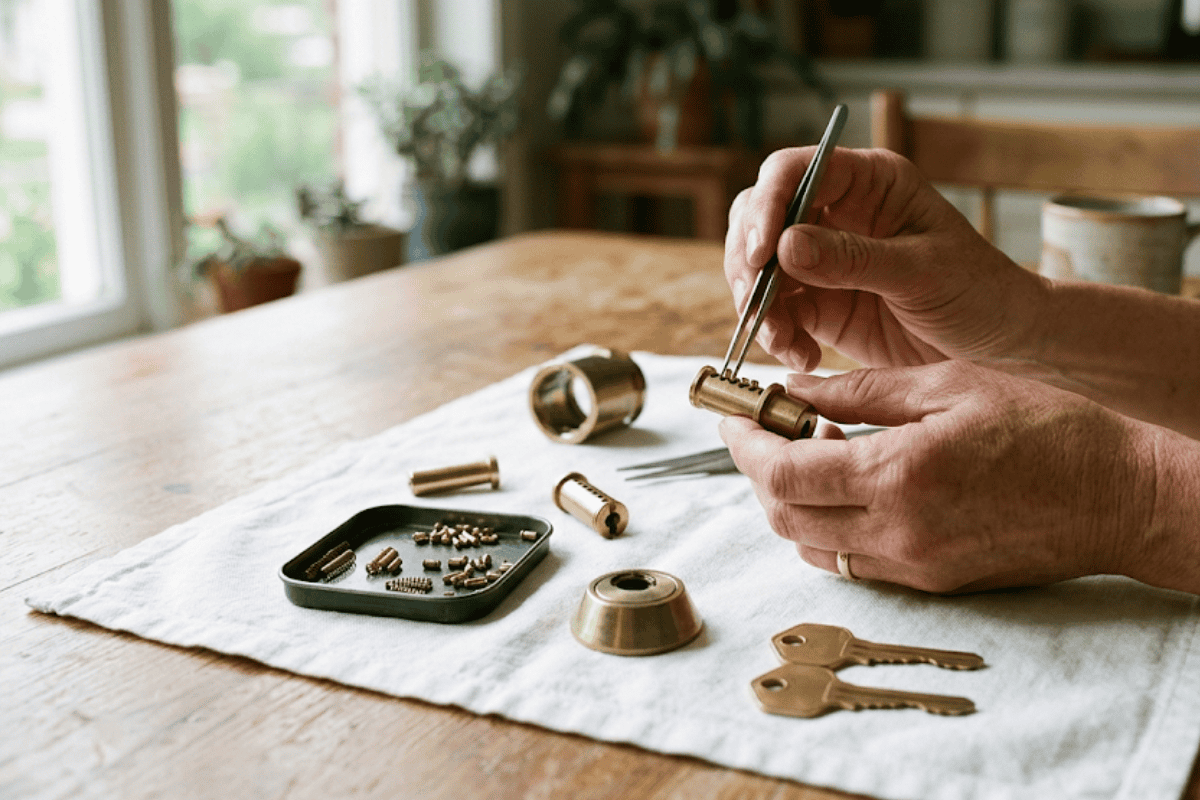
A pin tumbler lock works by lining up a stack of pins at a precise height called the shear line. Each cut on the key lifts one pin stack, and when all of them sit exactly at the shear line, the plug turns. Rekeying replaces the bottom pins with a set sized to a different key, so the old key lifts them to the wrong heights and the lock stays shut. Nothing about the door hardware changes; only the pins and the keys do. Our post on how rekeying works walks through this in detail with the plug and follower in hand.
Because rekeying keeps the existing hardware, it makes sense only when the lock is in good condition. Bob Vila’s comparison of whether to rekey or replace draws the line the same way: rekey a lock that works smoothly, replace one that sticks, is corroded, or was never a quality lock to begin with.
Can You Rekey a Lock Yourself Without a Locksmith? These Locks, Yes
The easiest case is a lock with a user-rekeyable cylinder. Kwikset’s SmartKey design lets you rekey with the current working key, a small learning tool, and the new key, and the manufacturer’s own SmartKey instructions are three steps long. Insert the working key and turn it, insert the tool into the small hole beside the keyway, remove the old key, insert the new key, and turn it back. No pins, no disassembly.
The next tier is a standard pin tumbler knob or deadbolt from a major brand for which a matching rekey kit is sold. Schlage publishes a Schlage guide covering its knobs, levers, deadbolts, and keypad locks, and Family Handyman’s step-by-step project shows the full procedure with photos: remove the knob, pull the cylinder, push the plug out with the follower, dump the old pins, use the key gauge to read the new key, drop in the matching pins, and reassemble. Kits are brand-specific because Kwikset, Schlage, and others use different keyways and pin sizes, so a Schlage kit will not rekey a Kwikset lock.
The tier you should leave alone includes high-security cylinders with security pins or restricted keyways, most commercial hardware, mortise locks, older locks with worn or nonstandard parts, and any lock where you no longer have a working key. Without a working key, the plug cannot be turned to remove it without picking or shimming, which is locksmith territory.
Doing It Yourself, Kwikset SmartKey, or a Locksmith
| Factor | Kwikset SmartKey (user rekey) | Pin kit, do it yourself | Professional locksmith |
|---|---|---|---|
| Time per lock | Under a minute | 30 to 60 minutes for a first-timer | 10 to 30 minutes |
| Requires a working key | Yes | Yes, to remove the plug | No |
| Works on mixed brands | Kwikset SmartKey only | One kit per brand | Yes, including keying all doors alike |
| Key cutting | Uses precut keys from the kit | Uses precut keys from the kit | Cut on site, any quantity |
| High-security or commercial locks | No | Not recommended | Yes |
| Main risk | Lock resets if the tool is inserted wrong | Dropped springs, wrong pin sizes, a lock that no longer turns | Choosing an unverified provider |
Reading across the rows: Kwikset SmartKey takes under a minute per lock, a pin-kit rekey takes 30 to 60 minutes for a first-timer, and a professional locksmith takes 10 to 30 minutes. SmartKey and a pin kit both require a working key, the kit because you need it to remove the plug, while a locksmith does not. SmartKey works only on Kwikset SmartKey locks, a pin kit works on one brand per kit, and a locksmith handles mixed brands including keying all doors alike. SmartKey and pin kits use precut keys from the kit, while a locksmith cuts keys on site in any quantity. Neither SmartKey nor a pin kit is suited to high-security or commercial locks, which a locksmith handles. The main risk with SmartKey is a lock that resets if the tool is inserted wrong, with a pin kit it is dropped springs, wrong pin sizes, and a lock that no longer turns, and with a locksmith it is choosing an unverified provider.
The Mistakes That Turn a Rekey Into a Replacement
The follower is the part beginners skip. When the plug slides out of the cylinder housing, the top pins and springs above it are held in place only by the follower pushed in behind the plug. Pull the plug without a follower and six springs launch across the room, and the lock is finished until every one is found and reseated. The second common error is misreading the key. Each cut depth corresponds to a specific pin length, and a pin one size off will let the key enter but not turn, or turn but bind. The third is over-lubrication with an oil that gums the pins; a dry graphite or PTFE lubricant is what locksmiths use. The fourth is working on a lock that was worn to begin with. Rekeying a cylinder that already sticks does not fix the sticking, and BHMA’s BHMA ratings explain why: residential locks are graded A, B, and C on security, durability, and finish, and a low-grade cylinder that has reached the end of its cycle life needs replacement, not new pins.
When Calling a Locksmith Is the Better Choice
There are four situations where a professional is faster and usually cheaper once the value of your time and a possible replacement are counted:
- You have no working key for the lock, which means the plug cannot be removed without picking
- Your doors use different brands and you want them all on a single key
- Any lock is high-security, commercial grade, or a mortise style
- You have more than three or four locks to do and would rather it take an hour than an afternoon
A locksmith also cuts keys on site, so you can walk away with as many copies as the household needs, instead of the two that come in a kit.
Why Choose Tulsa Lock & Key When the DIY Route Runs Out
The most common rekey call Tulsa Lock & Key receives from Tulsa, Oklahoma homeowners after a do-it-yourself attempt is a cylinder with the plug out, springs missing, and a door that no longer locks, and the technician’s first job is deciding whether the cylinder can be repinned or should be replaced. Because the company stocks pin kits for the major residential brands and cuts keys on site, it can finish a stalled project, rekey the remaining doors to the same key, and hand over as many copies as the family needs in one visit. Rekeying is one of the fastest and most affordable ways to secure your doors, and it is a core part of the residential locksmith work the company has done in Tulsa since 1985. Technicians explain whether a rekey or a replacement makes sense for each lock without upselling, and estimates are free.
Halfway through a rekey and stuck? Call or contact Tulsa Lock & Key for a free estimate on finishing the job and keying every door alike.
Conclusion
You can rekey a lock yourself without a locksmith if it is a user-rekeyable design like Kwikset SmartKey or a standard pin tumbler lock from a brand that sells a matching kit, and you still have a working key. The job takes patience, a follower, and careful pin sizing. High-security, commercial, mortise, worn, or keyless-you-lost-it locks belong with a professional, and so does any home where you want every door on one key. Weigh the time, the risk of a dropped spring, and the number of locks before you decide.
Want every exterior door on one key without the afternoon of trial and error? Contact Tulsa Lock & Key for a free consultation in Tulsa, Oklahoma.
Frequently Asked Questions
Can I rekey my own locks?
Yes, if the lock is a user-rekeyable design such as Kwikset SmartKey or a standard pin tumbler lock with a matching brand-specific kit, and you have a working key. High-security, commercial, and mortise locks are best left to a locksmith.
How do you rekey a lock yourself?
Remove the knob or deadbolt cylinder, push the plug out with a follower while keeping the top pins in place, dump the old bottom pins, read the new key with the kit’s gauge, insert the matching pins, and reassemble. Test the new key before reinstalling the lock on the door.
Can you rekey a lock without the original key?
Not with a retail kit, because the plug must be turned to remove it. A locksmith can pick or shim the lock open, then rekey it normally.
Is it cheaper to rekey or replace a lock?
Rekeying is cheaper because the existing hardware stays in place and only the pins and keys change. Replacement makes sense when the lock is worn, damaged, or low quality.
What tools do I need to rekey a lock?
A brand-specific rekey kit with pins, a plug follower, a key gauge, tweezers, a small screwdriver, and the working key. Kwikset SmartKey locks need only the SmartKey learning tool and the new key.
Sorry, the comment form is closed at this time.