

02 Jul How Do Door and Window Sensors on an Alarm System Work?
It looks like magic when your phone buzzes the instant a door opens, but once you learn how do door and window sensors on an alarm system work, you will see it is elegantly simple: two small pieces — a magnet and a switch — team up to notice the exact moment a door or window separates from its frame. That tiny break in an invisible circuit is what tells your system someone just opened up. For homeowners in Tulsa, OK, understanding this basic mechanism makes it far easier to trust your system, troubleshoot a nuisance fault, and know where extra sensors are worth adding.
At Tulsa Lock & Key, we install these security sensors throughout the metro, so let us open up the mechanism and show you how it works.
How Do Door and Window Sensors on an Alarm System Work?
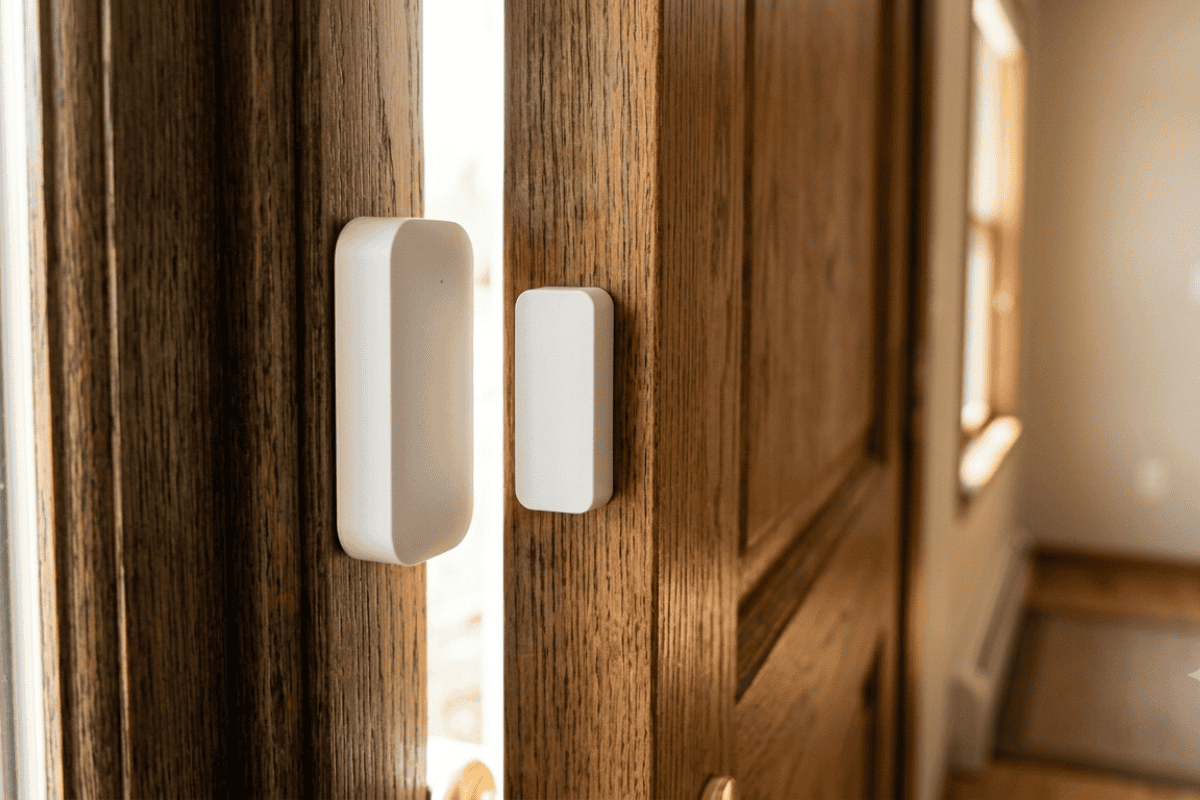
A standard contact sensor comes in two parts. One part is a magnet, mounted on the moving door or window itself. The other part is the sensor body, which contains a reed switch and is mounted on the fixed frame right next to the magnet. When the door is closed, the magnet sits close enough to hold the reed switch shut, completing a small electrical circuit. The system reads that closed circuit as “secure.”
The instant the door or window opens, the magnet moves away from the switch. Without the magnet nearby, the reed switch springs open, breaking the circuit. Your control panel notices the broken connection and, if the system is armed, triggers the alarm and sends an alert. Some sensors use a solid-state magnetic sensor instead of a mechanical reed, but the principle is identical: separate the magnet from the sensor, and the system knows.
The Parts Working Together
It helps to see how each piece plays its role. The magnet is mounted on the moving door or window and its job is to hold the switch closed. The sensor body, containing the reed switch, is mounted on the fixed frame and opens the circuit when the magnet moves away. The control panel acts as the central hub, detecting the broken circuit and deciding whether to alert. For windows especially, a glass break detector mounted nearby listens for the sound of shattering glass, and a motion sensor in the room interior detects movement as an extra layer.
| Part / sensor | Where it’s mounted | What it does |
|---|---|---|
| Magnet | On the moving door or window | Holds the switch closed |
| Sensor body (reed switch) | On the fixed frame | Opens the circuit when the magnet moves away |
| Control panel | Central hub | Detects the broken circuit and decides to alert |
| Glass break detector | Near windows | Listens for the sound of shattering glass |
| Motion sensor | Room interior | Detects movement as an extra layer |
Together, these layers cover the two ways an intruder gets in: opening a door or window, or breaking through the glass itself. Call Tulsa Lock & Key at (918) 664-5010 to have contact sensors installed on every vulnerable opening.
Types of Contacts and How They Differ
Contact sensors come in a few styles to suit different doors and aesthetics, but they all rely on the same magnet-and-switch logic. Surface-mount contacts attach visibly to the door and frame and are the easiest to install, while recessed contacts are hidden inside a drilled hole for a clean, concealed look. Wireless versions communicate with the panel by radio and run on small batteries, whereas wired versions connect directly to the panel through low-voltage wiring. Roller-ball and overhead-door contacts handle specialty openings like garage doors.
Contact sensors are usually paired with other detectors so no single failure leaves you exposed. A motion sensor inside a room, for example, can catch someone who slips past a window, giving you overlapping coverage that is much harder to defeat. Combining these sensors with strong locks means an intruder faces both a physical barrier and an instant alert.
Why Choose Tulsa Lock and Key
Tulsa Lock & Key has secured homes across Tulsa, OK for decades, and our technicians know how to place contact sensors so they catch real entries without constant false trips. We assess every door, window, and specialty opening, recommend the right mix of surface, recessed, wireless, and wired sensors, and make sure your panel is set up to alert you reliably. Our people-first approach means we explain how everything works and answer your questions honestly. When you want a system that genuinely watches every opening, our local team delivers.
Want every door and window covered? Contact Tulsa Lock & Key to design your sensor layout.
Conclusion
So, how do door and window sensors on an alarm system work? A magnet on the moving part keeps a reed switch closed, and the moment the door or window opens, the magnet pulls away, the circuit breaks, and your panel raises the alarm. Add glass break and motion detectors, and you have layered protection that covers every way in.
If you want that peace of mind anywhere in the Tulsa area, call Tulsa Lock & Key and let our experts protect every opening in your home.
Frequently Asked Questions
How do door sensors know when a door is opened?
Door sensors use two parts, a magnet on the door and a magnetic switch on the frame, that stay aligned when the door is closed. This keeps a small electrical circuit complete, which the system reads as secure. When the door opens, the magnet moves away, the circuit breaks, and the alarm system registers the opening.
Can I open a window with the alarm on?
If the system is armed and the window has a contact sensor, opening it will break the circuit and trigger the alarm. Most systems let you “bypass” a specific window when arming, so you can leave it open on purpose without setting off the siren. You can also arm in a home or “stay” mode that treats interior sensors differently.
What is the magnet for on a door sensor?
The magnet holds the sensor’s internal switch closed while the door or window is shut. As long as the magnet stays close to the switch, the circuit remains complete and the system stays quiet. When the magnet moves away with the opening door, the switch releases and the alarm is triggered.
Do door sensors detect motion?
No, a standard door or window contact sensor only detects the opening of that specific door or window, not movement in a room. Detecting movement is the job of a separate motion sensor, which many systems include for interior coverage. Using both together gives you layered protection.
Can door and window sensors be bypassed?
They can be intentionally bypassed in your system settings when you want to leave a door or window open without triggering the alarm. A determined intruder might also try to defeat a sensor, which is why pairing contacts with motion detectors and glass break sensors is recommended. Layered sensors make bypassing the whole system much harder.
Sorry, the comment form is closed at this time.